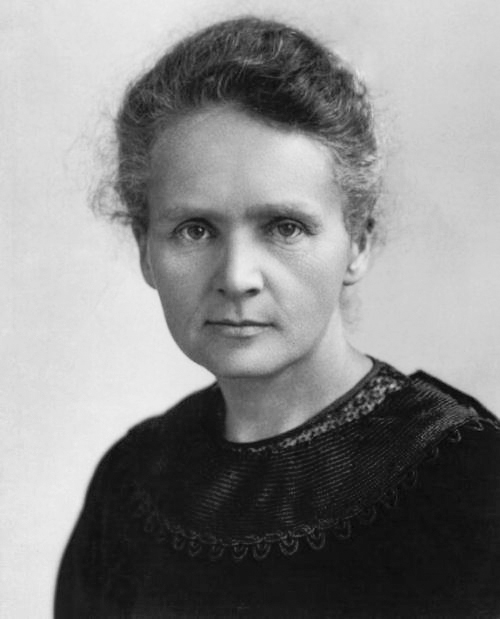
Marie Curie
A pioneering physicist and chemist who conducted groundbreaking research on radioactivity and discovered two new elements.
This biography of Marie Curie helps you learn English through real historical stories.
born1867
died1934
nationalityPolish-French
known forresearch on radioactivity and discovery of polonium and radium
fieldphysics and chemistry
Key Takeaways
- She coined the term radioactivity and discovered two new elements
- She was the first woman to win a Nobel Prize
- She is the only person to win Nobel Prizes in two different scientific fields
- She developed mobile X-ray units used during World War I
Life Timeline
1867
Born in Warsaw, Poland
1891
Moved to Paris to study at the Sorbonne
1898
Discovered the elements polonium and radium
1903
Became the first woman to win a Nobel Prize (in Physics)
1911
Won her second Nobel Prize (in Chemistry)
1934
Died from illness caused by radiation exposure
Biography Reading: Marie Curie
background
Marie Curie was born in 1867 in Warsaw, Poland. Growing up in a family of teachers, she developed a deep love for learning. However, because women were not allowed to attend regular universities in her home country, she had to study in secret. Eventually, she saved enough money to move to Paris in 1891 to attend the Sorbonne. Despite living in poverty and often going hungry, her incredible determination helped her graduate at the top of her class in physics and mathematics.
achievement
In Paris, she met and married Pierre Curie, a brilliant scientist who shared her passion. Together, they began investigating the mysterious energy emitted by uranium. Marie coined the term "radioactivity" to describe this phenomenon. Through years of exhausting physical labor, purifying tons of pitchblende in a drafty shed, they discovered two entirely new, highly radioactive elements in 1898: polonium (named after her homeland) and radium. This monumental discovery changed the fundamental understanding of matter and atomic energy.
impact
Marie Curie's groundbreaking research earned her immense recognition, making her the first woman to win a Nobel Prize and the only person to win in two different scientific fields (physics and chemistry). During World War I, she also developed mobile X-ray units to treat wounded soldiers on the battlefield. Tragically, her constant exposure to radiation, the very thing she discovered, eventually caused her death in 1934. Today, she is remembered as a fearless pioneer whose relentless dedication paved the way for modern physics and medical treatments.
Essential Vocabulary
determination
the quality of trying to do something even when it is difficult
emit
to send out light, sound, or a smell, or a gas
radioactivity
the sending out of radiation when the nucleus of an atom breaks apart
phenomenon
a fact or an event in nature or society, especially one that is not fully understood
monumental
very important and having a great influence
pioneer
a person who is one of the first to do something
Knowledge Check Quiz
FACTUAL1 / 4
Which two elements did Marie Curie discover?
Flashcards
Flashcard
Who was Marie Curie?
A pioneering physicist and chemist who researched radioactivity.
1 / 9