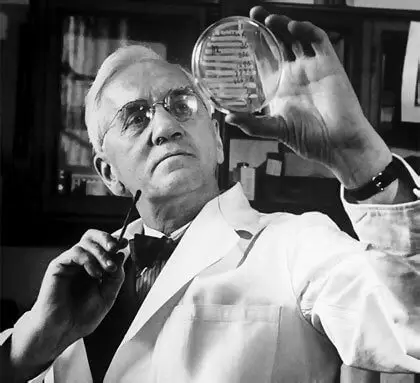
Alexander Fleming
A Scottish physician and microbiologist best known for discovering penicillin, the world's first broadly effective antibiotic, revolutionizing modern medicine.
This biography of Alexander Fleming helps you learn English through real historical stories.
born1881
died1955
nationalityScottish
known fordiscovering penicillin and lysozyme
fieldmicrobiology and pharmacology
Key Takeaways
- He discovered penicillin in 1928 after noticing a mold destroying bacteria in a petri dish
- His discovery ushered in the era of antibiotics, revolutionizing modern medicine
- He shared the 1945 Nobel Prize in Medicine with Florey and Chain, who helped mass-produce the drug
- He served in WWI, where the tragedy of infected wounds inspired his research into antibacterial agents
Life Timeline
1881
Born in Lochfield, Scotland
1906
Graduated with distinction from St Mary's Hospital Medical School
1922
Discovered the enzyme lysozyme
1928
Discovered penicillin from a mold colony
1945
Awarded the Nobel Prize in Physiology or Medicine
1955
Died in London, England
Biography Reading: Alexander Fleming
background
Sir Alexander Fleming was born in 1881 in rural Scotland. After moving to London and working in a shipping office, a serendipitous inheritance allowed him to attend St Mary's Hospital Medical School. He proved to be a brilliant student and soon joined the research department under Almroth Wright, a pioneer in vaccine therapy. During World War I, Fleming served in the Royal Army Medical Corps, where witnessing the horrific death toll from infected wounds fueled his lifelong quest to find better antibacterial agents.
achievement
Fleming's most famous discovery occurred in September 1928, famously driven by a stroke of luck and a messy laboratory. Upon returning from a family vacation, he noticed that a petri dish containing Staphylococcus bacteria had been accidentally contaminated with a fungus. Strikingly, the bacteria immediately surrounding the fungus had been destroyed. He identified the mold as belonging to the Penicillium genus and named the active antibacterial substance "penicillin." He realized this substance could kill a wide range of harmful bacteria without being toxic to human cells.
impact
Although Fleming published his findings in 1929, it took over a decade and the collaborative brilliance of scientists Howard Florey and Ernst Chain to successfully purify and mass-produce penicillin. During World War II, this "miracle drug" saved countless lives from infection and amputations, ushering in the era of antibiotics. In 1945, Fleming, Florey, and Chain shared the Nobel Prize in Medicine. True to his humble nature, Fleming always maintained that "Nature makes penicillin, I just found it," yet his sharp observation fundamentally transformed global healthcare and human life expectancy.
Essential Vocabulary
serendipitous
occurring or discovered by chance in a happy or beneficial way
antibacterial
active against bacteria
contaminated
having been made impure by exposure to or addition of a poisonous or polluting substance
fungus
any of a group of spore-producing organisms feeding on organic matter, including molds, yeast, and mushrooms
purify
remove contaminants from
amputation
the surgical removal of all or part of a limb or extremity
Knowledge Check Quiz
FACTUAL1 / 4
What is the name of the active antibacterial substance Alexander Fleming discovered in 1928?
Flashcards
Flashcard
Who discovered penicillin?
Alexander Fleming.
1 / 9