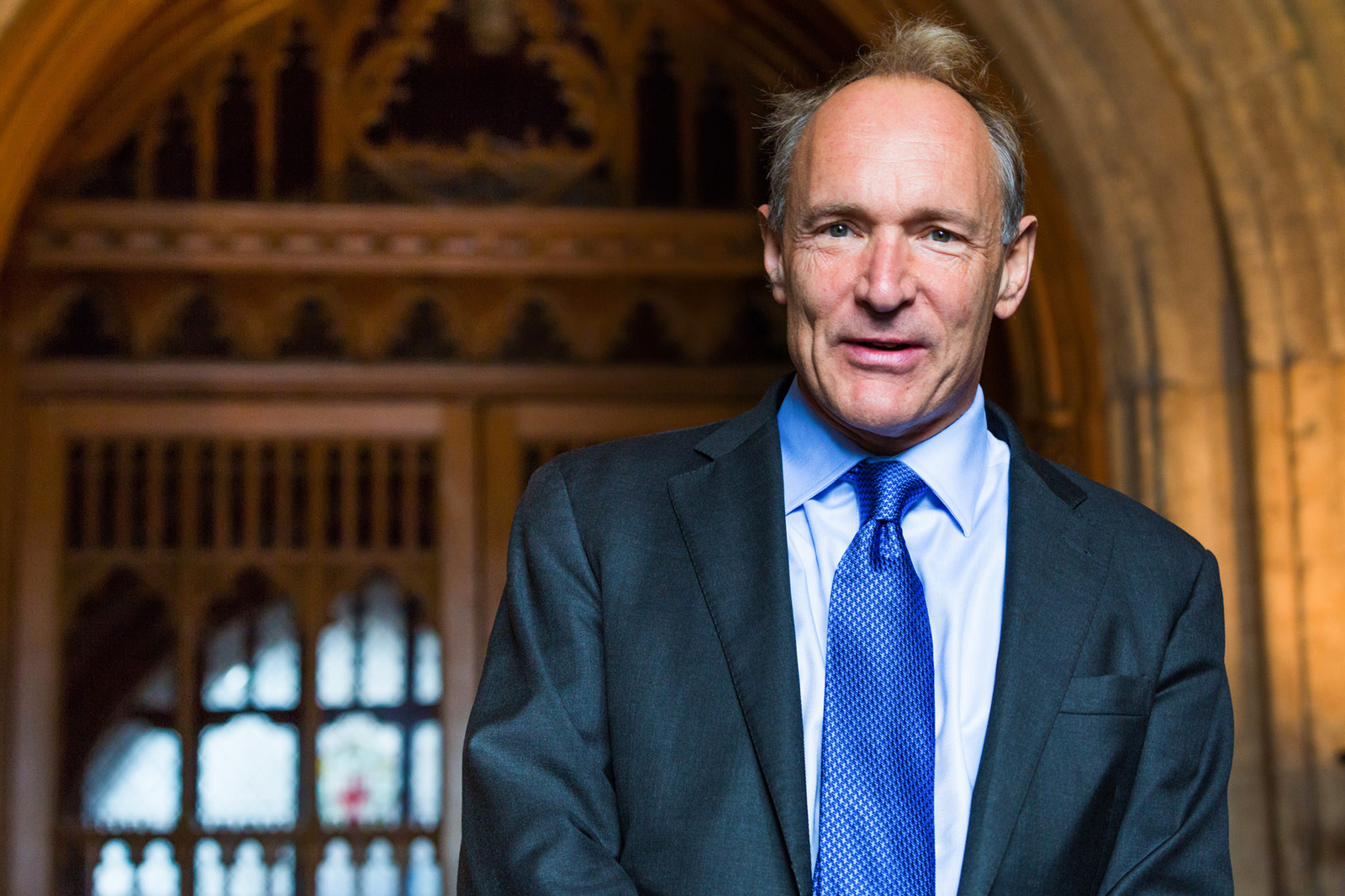
Tim Berners Lee
An English computer scientist best known as the inventor of the World Wide Web, revolutionizing global information sharing.
This biography of Tim Berners Lee helps you learn English through real historical stories.
born1955
diedPresent
nationalityEnglish
known forinventing the World Wide Web (WWW), HTML, URI, HTTP
fieldcomputer science
Key Takeaways
- He invented the World Wide Web (WWW) while working at CERN in 1989
- He created the foundational technologies of the web: HTML, URI (URL), and HTTP
- He made the Web entirely free and open to the public rather than patenting it for profit
- He founded the W3C to maintain web standards and advocates for digital privacy
Life Timeline
1955
Born in London, England
1989
Proposed an information management system that became the Web
1990
Wrote the first web browser and server at CERN
1991
The World Wide Web became publicly available
1994
Founded the World Wide Web Consortium (W3C)
2004
Knighted by Queen Elizabeth II
Biography Reading: Tim Berners Lee
background
Sir Tim Berners-Lee, born in London in 1955, is the English computer scientist who forever changed the course of human history by inventing the World Wide Web. His parents were both early computer pioneers who worked on the Ferranti Mark 1, the first commercially built computer. Following in their footsteps, he studied physics at Oxford University before working as an independent contractor at CERN, the European Organization for Nuclear Research in Switzerland. It was there, amidst the frustration of researchers unable to easily share information across different computers, that the seed of a revolutionary idea was planted.
achievement
In 1989, Berners-Lee proposed a global hypertext project to facilitate sharing and updating information among researchers. By 1990, he had written the first web browser, the first web server, and defined the fundamental technologies that still power the internet today: HTML (Hypertext Markup Language), URI (Uniform Resource Identifier, now known as URL), and HTTP (Hypertext Transfer Protocol). Crucially, instead of patenting his creation to amass personal wealth, he and CERN decided to make the source code completely free and available to the public in 1991, ensuring the Web would be an open platform for everyone.
impact
To protect the open nature of his invention, Berners-Lee founded the World Wide Web Consortium (W3C) in 1994, which creates standards to ensure the Web continues to function seamlessly across the globe. Today, he remains a vocal advocate for digital rights, net neutrality, and data privacy, frequently warning against the centralization of the web by large tech corporations. His monumental contribution has democratized information, transformed global commerce, and interconnected humanity in ways previously unimaginable, earning him a knighthood and the Turing Award, often considered the "Nobel Prize of Computing."
Essential Vocabulary
hypertext
a software system that links topics on the screen to related information and graphics
patent
to obtain a government authority conferring a right or title, especially the sole right to exclude others from making, using, or selling an invention
centralization
the concentration of control of an activity or organization under a single authority
democratize
to make something accessible to everyone
seamlessly
smoothly and continuously, with no apparent gaps or spaces between one part and the next
consortium
an association, typically of several business companies or organizations
Knowledge Check Quiz
FACTUAL1 / 4
In which organization was Tim Berners-Lee working when he invented the World Wide Web?
Flashcards
Flashcard
Who invented the World Wide Web?
Tim Berners-Lee.
1 / 9