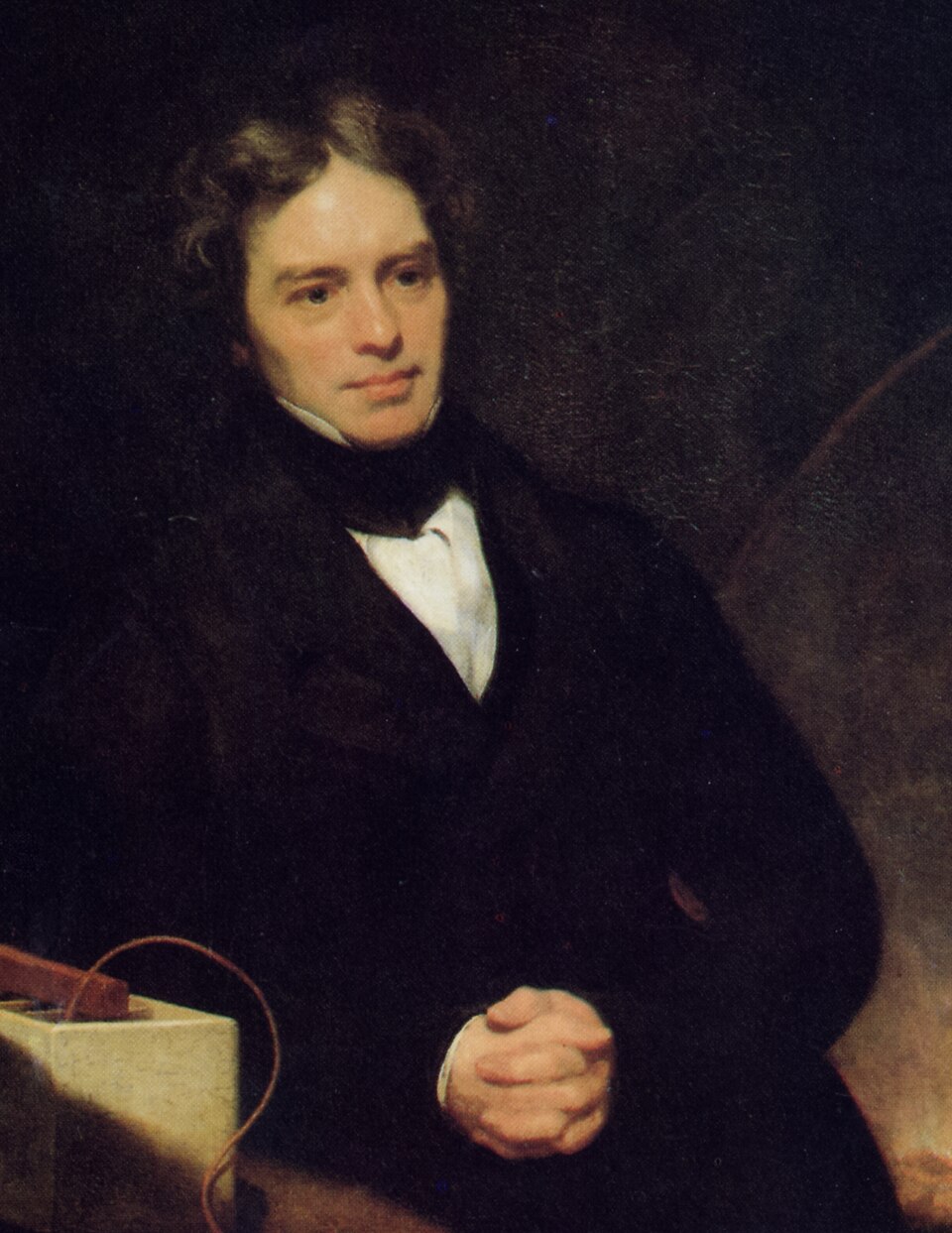
Michael Faraday
An English scientist whose foundational discoveries in electromagnetism and electrochemistry made electricity a practical source of power for the modern world.
This biography of Michael Faraday helps you learn English through real historical stories.
born1791
died1867
nationalityEnglish
known forelectromagnetic induction, the electric motor, and the Faraday cage
fieldphysics and chemistry
Key Takeaways
- He started as a bookbinder's apprentice and became one of history's greatest scientists
- He invented the first electric motor, converting electrical energy into mechanical motion
- He discovered electromagnetic induction, paving the way for the invention of electric generators
- He introduced the concept of electromagnetic fields and invented the Faraday cage
Life Timeline
1791
Born in Newington Butts, London
1812
Attended lectures by Humphry Davy and became his assistant
1821
Invented the first electric motor
1831
Discovered electromagnetic induction, leading to the electric generator
1836
Invented the Faraday cage to block electromagnetic fields
1867
Died in Hampton Court, London
Biography Reading: Michael Faraday
background
Michael Faraday was born in 1791 in London to a poor, working-class family. Receiving only a basic formal education, he began working as an errand boy and later an apprentice bookbinder at the age of 14. Surrounded by books, he developed a voracious appetite for reading, particularly works on science and electricity. His life changed completely in 1812 when he attended lectures by the eminent chemist Humphry Davy. Faraday bound his detailed notes from these lectures into a book and sent them to Davy, who was so impressed that he hired the young man as his laboratory assistant.
achievement
Working at the Royal Institution, Faraday transitioned from a humble assistant into one of the greatest experimental scientists in history. In 1821, he built the first electric motor, demonstrating that electrical energy could be converted into mechanical motion. A decade later, in 1831, he made his most crucial breakthrough: electromagnetic induction. By moving a magnet through a coil of copper wire, he generated an electric current. This monumental discovery proved that magnetism could produce electricity, leading directly to the invention of the electric transformer and the electric generator, the very foundation of the modern power grid.
impact
Despite his lack of advanced mathematical training, Faraday's brilliant physical intuition allowed him to visualize invisible forces, introducing the concept of "lines of force" or electromagnetic fields. He also made major contributions to chemistry, including the discovery of benzene and the laws of electrolysis. In 1836, he invented the "Faraday cage," an enclosure that blocks external electromagnetic fields. A deeply humble and religious man, Faraday repeatedly declined a knighthood and the presidency of the Royal Society. Today, he is universally celebrated as the scientist who took electricity from a scientific curiosity and transformed it into a viable, world-changing source of power.
Essential Vocabulary
apprentice
a person who is learning a trade from a skilled employer
voracious
wanting or devouring great quantities of food or information
induction
the production of an electric or magnetic state by the proximity of an electrified or magnetized body
intuition
the ability to understand something immediately, without the need for conscious reasoning
enclosure
an area that is sealed off with an artificial or natural barrier
viable
capable of working successfully; feasible
Knowledge Check Quiz
FACTUAL1 / 4
What did Michael Faraday use to generate an electric current in 1831?
Flashcards
Flashcard
Who discovered electromagnetic induction?
Michael Faraday.
1 / 9