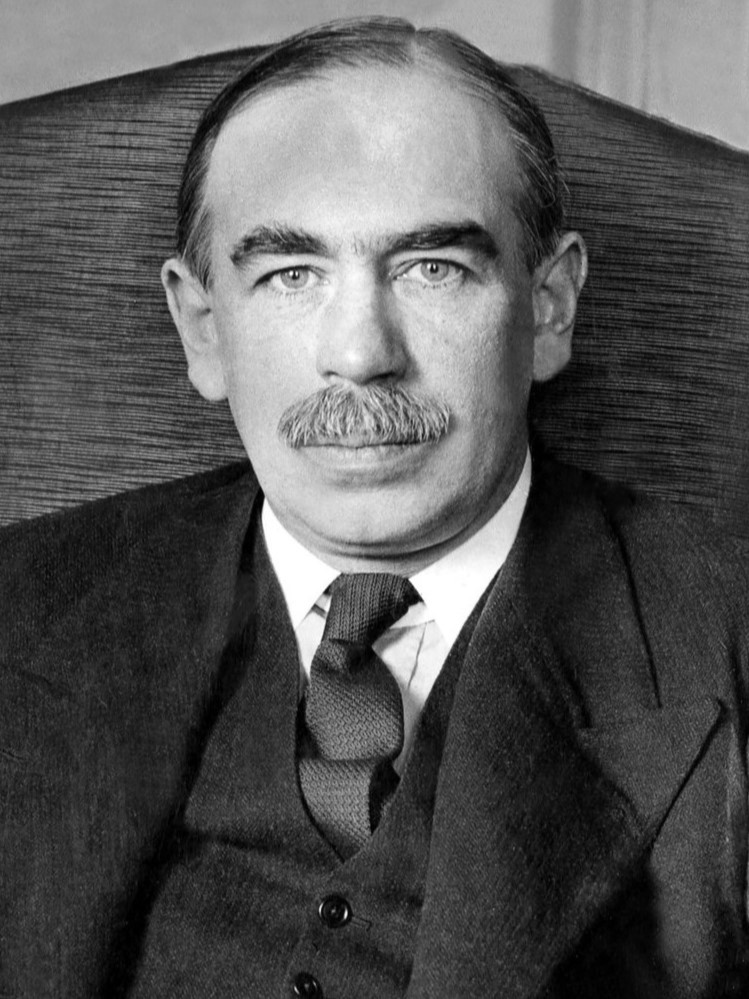
John M Keynes
A British economist whose ideas fundamentally changed the theory and practice of macroeconomics and the economic policies of governments.
This biography of John M Keynes helps you learn English through real historical stories.
born1883
died1946
nationalityBritish
known forKeynesian economics, The General Theory
fieldeconomics
Key Takeaways
- He is the founding father of modern macroeconomics and Keynesian economics
- He argued that government intervention and spending are necessary to manage economic recessions
- He wrote 'The General Theory', fundamentally changing how the world views free markets
- He helped establish the IMF and World Bank at the Bretton Woods Conference
Life Timeline
1883
Born in Cambridge, England
1919
Published 'The Economic Consequences of the Peace'
1936
Published 'The General Theory of Employment, Interest and Money'
1944
Played a central role at the Bretton Woods Conference
1946
Died in Sussex, England
Biography Reading: John M Keynes
background
John Maynard Keynes was born in 1883 in Cambridge, England, into an academic family. He studied mathematics at King's College, Cambridge, but soon developed a deep interest in economics under the guidance of Alfred Marshall. During World War I, he worked for the British Treasury, but he gained international fame in 1919 when he resigned in protest over the Treaty of Versailles. In his bestselling book, "The Economic Consequences of the Peace," he accurately predicted that the harsh reparations imposed on Germany would lead to economic ruin and future conflict.
achievement
The Great Depression of the 1930s shattered the classical economic belief that free markets would automatically provide full employment. Observing the prolonged mass unemployment, Keynes published his magnum opus, "The General Theory of Employment, Interest and Money" in 1936. He revolutionized economic thought by arguing that overall demand determines the level of economic activity. When private demand falls, he asserted, the government must step in to stimulate the economy through deficit spending, public works, and lower taxes, effectively managing the "boom and bust" cycles of capitalism.
impact
Keynes's ideas, which became known as "Keynesian economics," profoundly reshaped Western economic policies for decades following World War II. In 1944, he was a leading architect at the Bretton Woods Conference, helping to establish the International Monetary Fund (IMF) and the World Bank to rebuild the post-war global economy. Although the dominance of his theories waned in the 1970s with the rise of monetarism, his concepts saw a massive resurgence during the 2008 global financial crisis. Today, Keynes is widely regarded as the founding father of modern macroeconomics, proving that government intervention can be a vital tool for economic stability.
Essential Vocabulary
macroeconomics
the part of economics concerned with large-scale or general economic factors
reparations
the making of amends for a wrong one has done, by paying money to those who have been wronged
deficit spending
government spending, in excess of revenue, of funds raised by borrowing rather than from taxation
resurgence
an increase or revival after a period of little activity, popularity, or occurrence
stimulate
encourage development of or increased activity in a state or process
intervention
the action or process of intervening, especially government interference in economic affairs
Knowledge Check Quiz
FACTUAL1 / 4
What is the name of John Maynard Keynes's most famous book published in 1936?
Flashcards
Flashcard
Who is considered the founding father of modern macroeconomics?
John Maynard Keynes.
1 / 9