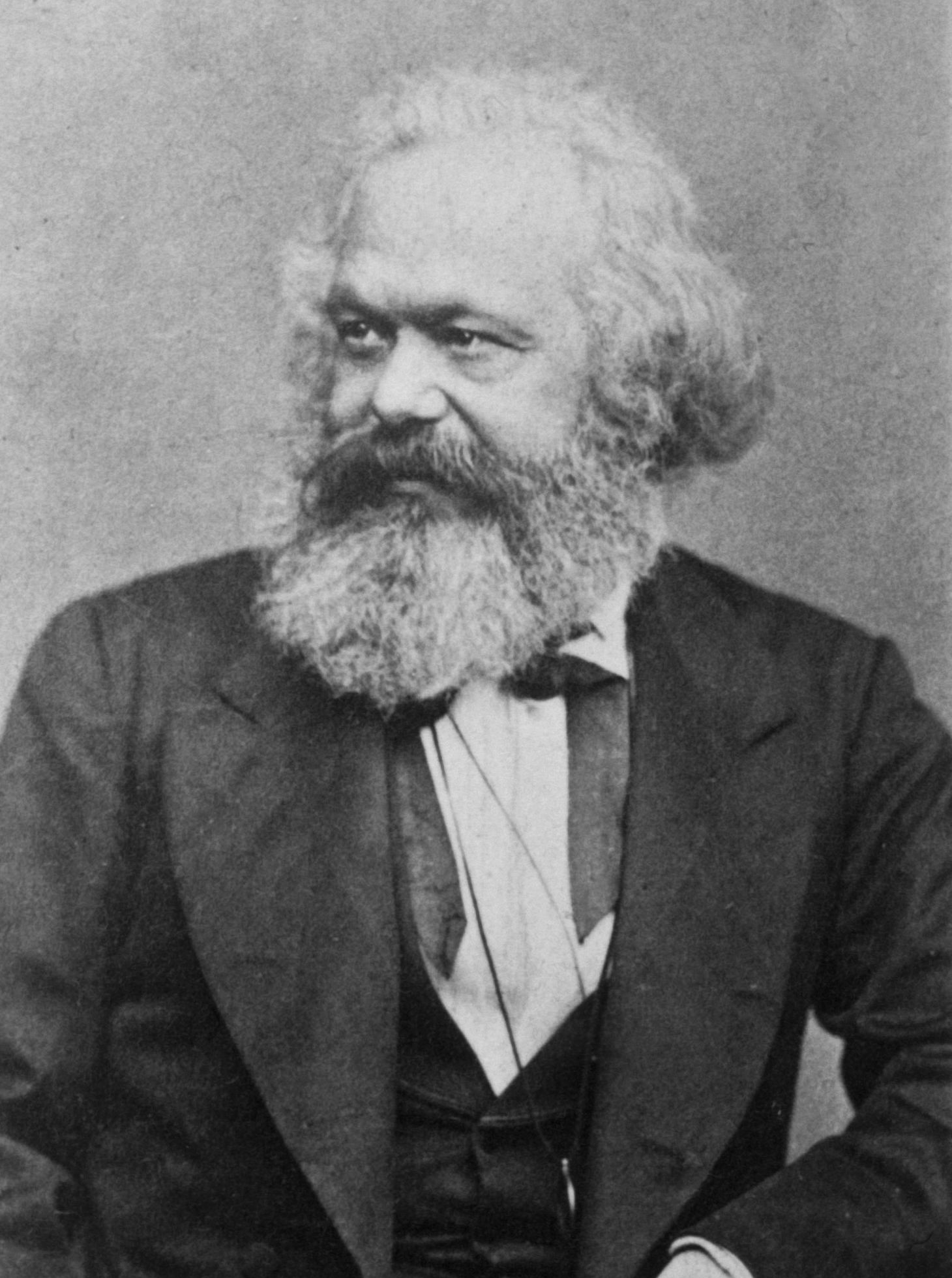
Karl Marx
A 19th-century German philosopher, economist, and revolutionary whose theories on capitalism and class struggle formed the basis of Marxism.
This biography of Karl Marx helps you learn English through real historical stories.
born1818
died1883
nationalityGerman
known forThe Communist Manifesto, Das Kapital, and founding Marxism
fieldphilosophy, economics, and political theory
Key Takeaways
- He co-authored The Communist Manifesto and wrote Das Kapital, foundational texts of Marxist theory
- He viewed human history as a continuous struggle between different social classes
- He argued that capitalism exploits the working class (proletariat) to generate surplus value for the owners (bourgeoisie)
- He predicted that a worker's revolution would ultimately establish a classless, stateless communist society
Life Timeline
1818
Born in Trier, Prussia
1848
Published 'The Communist Manifesto' with Friedrich Engels
1849
Exiled to London, where he spent the rest of his life
1867
Published the first volume of 'Das Kapital'
1883
Died in London, England
Biography Reading: Karl Marx
background
Karl Marx was born in 1818 in Trier, Prussia (modern-day Germany), into a middle-class family. He studied law and philosophy at the universities of Bonn and Berlin, where he became deeply influenced by the ideas of G.W.F. Hegel. As a young journalist and radical thinker, Marx’s sharp criticisms of European governments and social institutions frequently led to censorship and exile. He eventually settled in London, where he spent decades studying political economy in the reading room of the British Museum, supported financially and intellectually by his lifelong friend and collaborator, Friedrich Engels.
achievement
Marx is best known for his revolutionary critique of capitalism. In 1848, he and Engels published "The Communist Manifesto," a politically charged pamphlet that famously declared, "The history of all hitherto existing society is the history of class struggles." Marx argued that the capitalist system is inherently exploitative, built on the conflict between the "bourgeoisie" (the wealthy owners of the means of production) and the "proletariat" (the working class who must sell their labor to survive). He believed that capitalism inevitably alienates workers from the products of their labor and creates the very conditions that will lead to its own destruction.
impact
In his magnum opus, "Das Kapital" (1867), Marx meticulously analyzed the mechanics of capitalist production, focusing on concepts like "surplus value"—the unpaid labor from which capitalists derive their profits. He theorized that the proletariat would eventually unite, overthrow the capitalist class in a revolution, and establish a stateless, classless communist society where resources are distributed based on need. Although Marx died in relative obscurity in 1883, his ideas profoundly shaped the 20th century, inspiring major political revolutions in Russia, China, and across the globe, making him one of the most influential and controversial figures in human history.
Essential Vocabulary
bourgeoisie
the capitalist class who own most of society's wealth and means of production
proletariat
workers or working-class people, regarded collectively
exploitation
the action or fact of treating someone unfairly in order to benefit from their work
alienate
make someone feel isolated or estranged from their work or society
surplus value
the excess of value produced by the labor of workers over the wages they are paid
radical
advocating for complete political or social reform
Knowledge Check Quiz
FACTUAL1 / 4
Which famous pamphlet did Karl Marx publish in 1848 with Friedrich Engels?
Flashcards
Flashcard
Who co-authored 'The Communist Manifesto' with Karl Marx?
Friedrich Engels.
1 / 9