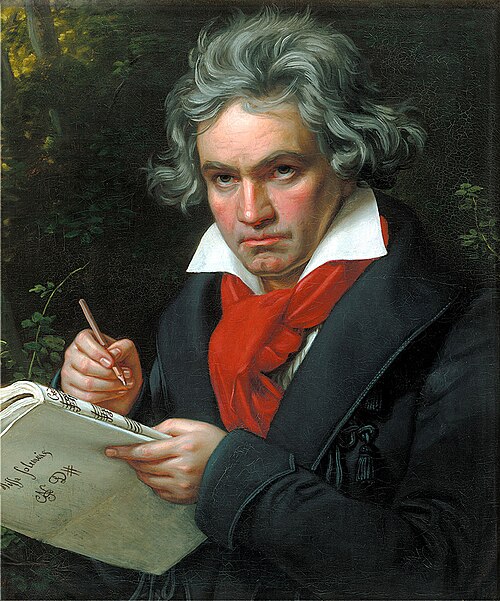
Beethoven
A brilliant German composer and pianist whose work marked the profound transition between the Classical and Romantic eras in Western music.
This biography of Beethoven helps you learn English through real historical stories.
born1770
died1827
nationalityGerman
known forSymphony No. 9, Symphony No. 5, and transitioning music to the Romantic era
fieldmusic and composition
Key Takeaways
- He was a crucial transitional figure between the Classical and Romantic eras of Western music
- Despite slowly going completely deaf, he continued to compose his greatest masterpieces
- His 'Heroic' period produced fiercely emotional and original works like Symphony No. 3 and Symphony No. 5
- His monumental Symphony No. 9 was the first to use a choir, featuring the famous 'Ode to Joy'
Life Timeline
1770
Born in Bonn, Germany
1792
Moved to Vienna to study with Joseph Haydn
1802
Wrote the Heiligenstadt Testament, revealing his despair over his deafness
1804
Premiered his Symphony No. 3 ('Eroica')
1824
Premiered Symphony No. 9, featuring the 'Ode to Joy'
1827
Died in Vienna, Austria
Biography Reading: Beethoven
background
Ludwig van Beethoven was born in 1770 in Bonn, Germany. Recognizing his prodigious musical talent early on, his father subjected him to a grueling and often abusive training regimen, hoping to mold him into the next Mozart. In 1792, Beethoven moved to Vienna, the musical capital of Europe, where he studied under the great Joseph Haydn. He quickly earned a reputation not only as a brilliant composer but also as a virtuoso pianist known for his powerful, emotionally charged improvisations that broke away from the strict, polite elegance of the Classical period.
achievement
Tragedy struck precisely as his career was ascending. Around his late twenties, Beethoven began losing his hearing. In his heartbreaking "Heiligenstadt Testament" of 1802, he confessed his deep despair and suicidal thoughts caused by his creeping deafness. Yet, he resolved to continue living for the sake of his art. This profound personal struggle ushered in his "Heroic" period, characterized by massive, fiercely original works like his Symphony No. 3 ("Eroica") and Symphony No. 5. His music became deeply personal, expressing themes of struggle, triumph, and the indomitable human spirit, effectively launching the Romantic era of music.
impact
By his final decade, Beethoven was almost completely deaf, yet he composed some of his most complex, transcendent masterpieces during this time. His crowning achievement was the monumental Symphony No. 9, the first symphony ever to include a choir, culminating in the triumphant "Ode to Joy." When he conducted its premiere in 1824, he had to be turned around to see the thunderous applause he could not hear. Beethoven died in 1827, leaving an unparalleled legacy. He fundamentally redefined the role of the composer, shifting music from mere aristocratic entertainment to a profound expression of individual emotion and philosophical thought.
Essential Vocabulary
regimen
a prescribed course of medical treatment, way of life, or diet for the promotion or restoration of health; a systematic plan
virtuoso
a person highly skilled in music or another artistic pursuit
improvisation
the act of creating and performing music, drama, or poetry spontaneously or without preparation
despair
the complete loss or absence of hope
indomitable
impossible to subdue or defeat
transcendent
beyond or above the range of normal or merely physical human experience
Knowledge Check Quiz
FACTUAL1 / 4
Which of Beethoven's symphonies was the first in history to include a choir?
Flashcards
Flashcard
Who composed Symphony No. 9 and the 'Ode to Joy'?
Ludwig van Beethoven.
1 / 9