Leonardo da Vinci
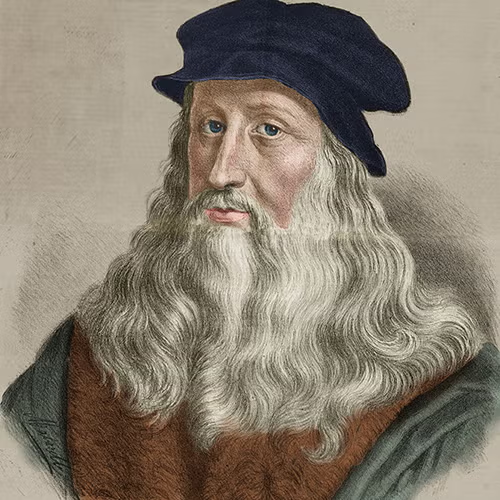
An Italian polymath of the High Renaissance who is widely considered one of the greatest painters of all time and a visionary scientist and engineer.
This biography of Leonardo da Vinci helps you learn English through real historical stories.
born1452
died1519
nationalityItalian
known forMona Lisa, The Last Supper, and visionary notebooks
fieldart, science, and engineering
Key Takeaways
- He is the ultimate 'Renaissance Man', excelling as both an artist and a scientist
- He painted iconic masterpieces like the 'Mona Lisa' and 'The Last Supper'
- He kept detailed notebooks with mirror script, sketching futuristic inventions like flying machines
- He conducted meticulous human dissections to create highly accurate anatomical drawings
Life Timeline
1452
Born in Vinci, Italy
1466
Became an apprentice to the artist Verrocchio in Florence
1495
Began painting 'The Last Supper' in Milan
1503
Began painting the 'Mona Lisa'
1519
Died in Amboise, France
Biography Reading: Leonardo da Vinci
background
Leonardo da Vinci was born in 1452 in the town of Vinci, Italy. As a young man, he received his early training in Florence under the renowned painter and sculptor Andrea del Verrocchio. During the High Renaissance, Leonardo's extraordinary talent quickly became evident. He mastered the technique of "sfumato," a method of blurring lines and blending colors to create soft, lifelike transitions. This mastery is most famously showcased in his iconic masterpieces, "The Last Supper" and the enigmatic "Mona Lisa," which remain among the most celebrated and studied artworks in human history.
achievement
While globally revered for his art, Leonardo's true genius lay in his insatiable curiosity and his belief that art and science were deeply intertwined. He filled thousands of notebook pages with detailed sketches, scientific diagrams, and observations written in a unique mirror script. He conceptualized flying machines, armored vehicles, and concentrated solar power centuries before the technology existed to build them. Furthermore, his anatomical drawings, based on the meticulous dissection of human corpses, provided an unprecedented understanding of the human body and muscular system.
impact
Despite his visionary mind, Leonardo frequently left projects unfinished, constantly distracted by his own endless stream of new ideas and experiments. He spent his final years in France under the patronage of King Francis I, dying in 1519. Today, Leonardo da Vinci remains the ultimate symbol of the "Renaissance Man"—a polymath of unquenchable curiosity and feverishly inventive imagination who saw no dividing line between the humanities and the sciences, leaving a legacy that transcends both time and discipline.
Essential Vocabulary
polymath
a person of wide-ranging knowledge or learning
enigmatic
difficult to interpret or understand; mysterious
insatiable
impossible to satisfy
intertwined
twisted or twined together; closely connected
meticulous
showing great attention to detail; very careful and precise
unquenchable
not able to be quenched or destroyed
Knowledge Check Quiz
FACTUAL1 / 4
Which of the following painting techniques is Leonardo famous for mastering?
Flashcards
Flashcard
Who painted the 'Mona Lisa' and 'The Last Supper'?
Leonardo da Vinci.
1 / 9