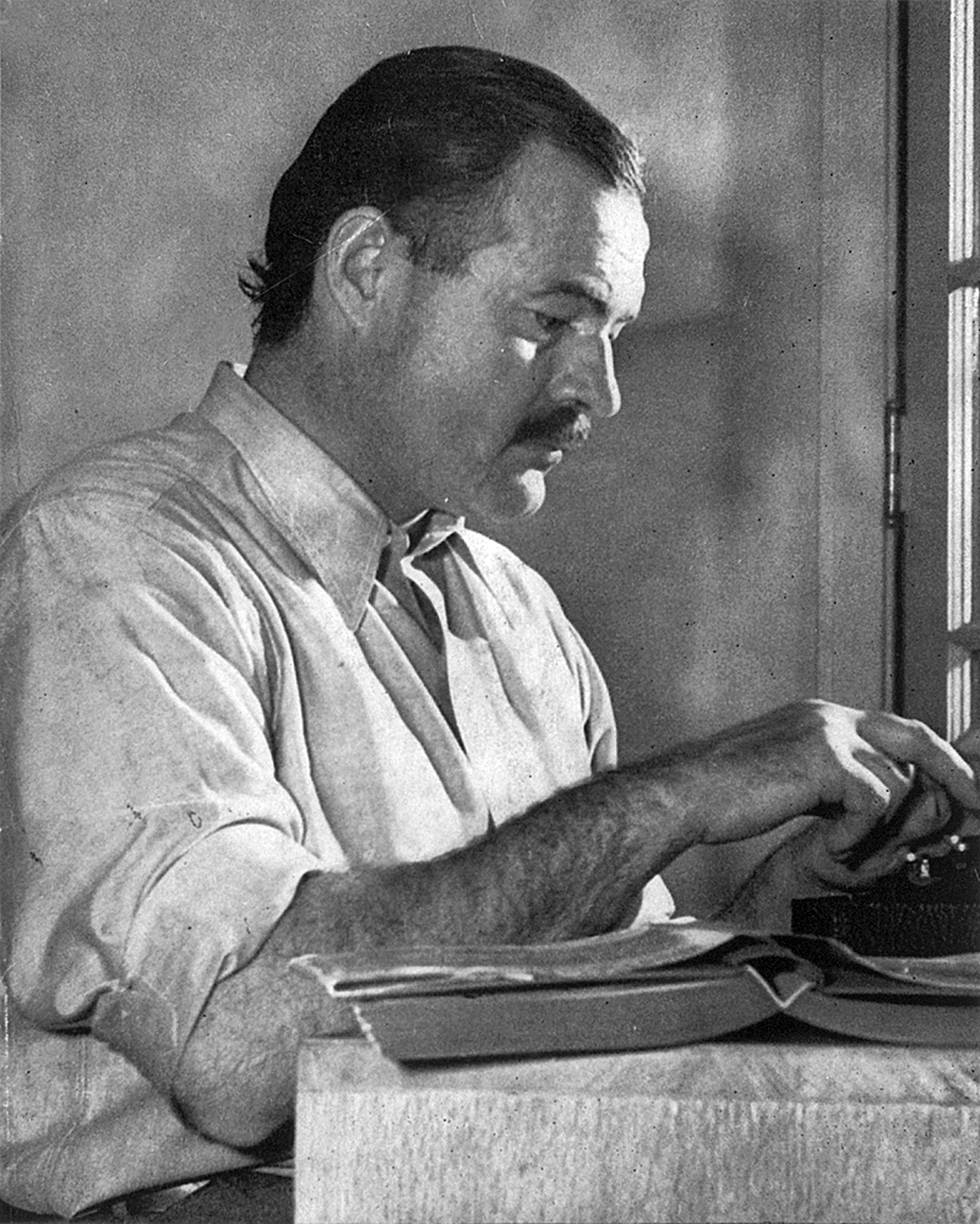
Ernest Hemingway
An iconic American novelist and short-story writer, Nobel Prize laureate, known for his economical, understated style and adventurous lifestyle.
This biography of Ernest Hemingway helps you learn English through real historical stories.
born1899
died1961
nationalityAmerican
known forThe Old Man and the Sea, A Farewell to Arms, and the Iceberg Theory
fieldliterature
Key Takeaways
- He was a central figure of the 'Lost Generation' of expatriate writers in Paris
- He developed the 'Iceberg Theory', a writing style characterized by economical and understated prose
- He won the Nobel Prize in Literature in 1954, partly for his masterpiece 'The Old Man and the Sea'
- He lived a highly adventurous life that heavily influenced his literary themes
Life Timeline
1899
Born in Oak Park, Illinois
1918
Served as an ambulance driver in WWI and was severely wounded
1926
Published his breakthrough novel, 'The Sun Also Rises'
1952
Published 'The Old Man and the Sea', winning the Pulitzer Prize
1954
Awarded the Nobel Prize in Literature
1961
Died in Ketchum, Idaho
Biography Reading: Ernest Hemingway
background
Ernest Hemingway was born in 1899 in Oak Park, Illinois. Shortly after high school, he volunteered as an ambulance driver in Italy during World War I. He was severely wounded by mortar fire, an experience that deeply affected him and provided the raw material for his classic novel, "A Farewell to Arms." After the war, he moved to Paris and became a central figure of the "Lost Generation," a group of expatriate writers and artists who were disillusioned by the horrors of the global conflict.
achievement
Hemingway is most famous for his revolutionary writing style, which he called the "Iceberg Theory" or the theory of omission. He believed that the deeper meaning of a story should not be evident on the surface, but should shine through implicitly, much like the massive, hidden underwater portion of an iceberg. His prose was characteristically sparse, economical, and objective, stripping away flowery adjectives to deliver a direct and powerful emotional punch. This distinct, masculine style profoundly influenced 20th-century fiction.
impact
Beyond his writing, Hemingway lived a highly publicized, adventurous life filled with bullfighting, deep-sea fishing, and big-game hunting across Spain, Cuba, and Africa. In 1952, he published "The Old Man and the Sea," a short, masterful novel about an aging Cuban fisherman's epic struggle with a giant marlin, which earned him the Pulitzer Prize and contributed to his 1954 Nobel Prize in Literature. Tragically, plagued by physical injuries and severe depression in his later years, Hemingway took his own life in 1961, leaving behind a monumental literary legacy.
Essential Vocabulary
economical
using no more of something than is necessary
expatriate
a person who lives outside their native country
omission
the action of excluding or leaving out someone or something
implicitly
in a way that is not directly expressed
sparse
thinly dispersed or scattered; austere
bullfighting
the traditional public entertainment of fighting with bulls
Knowledge Check Quiz
FACTUAL1 / 4
What is the name of Hemingway's writing style that focuses on what is left unsaid?
Flashcards
Flashcard
What was Hemingway's famous 'Theory of omission' called?
The Iceberg Theory.
1 / 9