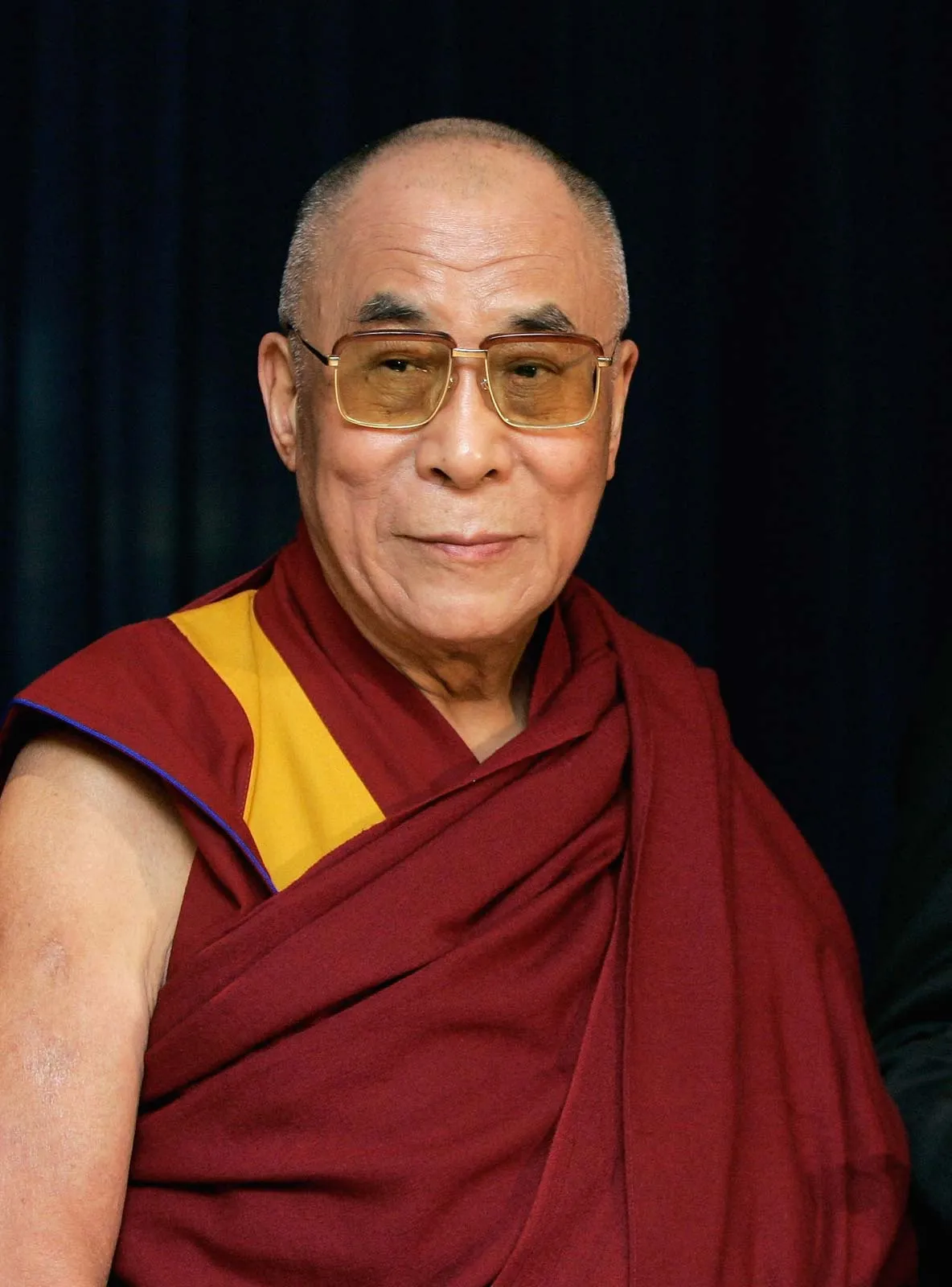
14th Dalai Lama
The spiritual leader of the Tibetan people and a global icon of peace, compassion, and non-violence, awarded the Nobel Peace Prize in 1989.
This biography of 14th Dalai Lama helps you learn English through real historical stories.
born1935
diedPresent
nationalityTibetan
known foradvocating for Tibetan autonomy and global peace through non-violence
fieldreligion, philosophy, and global peace
Key Takeaways
- He is the spiritual leader of Tibet and the 14th reincarnation of the Dalai Lama
- He has lived in exile in Dharamsala, India since fleeing the 1959 Tibetan uprising
- He won the 1989 Nobel Peace Prize for advocating non-violent solutions for Tibet
- He promotes the 'Middle Way Approach' and explores the intersection of Buddhism and science
Life Timeline
1935
Born Lhamo Thondup in Taktser, Amdo, Tibet
1937
Recognized as the reincarnation of the 13th Dalai Lama
1950
Assumed full political power after China's invasion of Tibet
1959
Fled into exile in India after the failed Tibetan uprising
1989
Awarded the Nobel Peace Prize
2011
Devolved his political authority to a democratically elected leadership
Biography Reading: 14th Dalai Lama
background
The 14th Dalai Lama, born Lhamo Thondup in 1935 in a small farming village in northeastern Tibet, was recognized at the age of two as the reincarnation of his predecessor. According to Tibetan Buddhist tradition, the Dalai Lamas are the earthly manifestations of Avalokiteshvara, the Bodhisattva of Compassion. He was brought to the capital city of Lhasa and underwent a rigorous monastic education encompassing logic, Tibetan culture, Sanskrit, medicine, and deep Buddhist philosophy. At just 15 years old, amidst the invasion of Tibet by the People's Republic of China, he was called upon to assume full political leadership of his people.
achievement
In 1959, following the brutal suppression of a Tibetan national uprising in Lhasa, the Dalai Lama was forced into exile. He undertook a perilous journey across the Himalayas to seek asylum in India, where he eventually established the Central Tibetan Administration in Dharamsala. For over six decades in exile, he has tirelessly advocated for the welfare of the Tibetan diaspora and the preservation of their unique cultural and religious identity. Despite the tragic loss of his homeland, he has strictly maintained a "Middle Way Approach," seeking genuine autonomy for Tibet within China through non-violent dialogue rather than absolute independence.
impact
Beyond his political and religious duties, the Dalai Lama has become a universally respected icon of peace and interfaith harmony. He was awarded the Nobel Peace Prize in 1989 for his unwavering commitment to non-violence. He is also uniquely known for his deep enthusiasm for modern science, actively engaging in dialogues with neuroscientists and quantum physicists to explore the intersections between scientific discovery and ancient Buddhist mindfulness. He famously summarizes his teachings by saying, "My religion is very simple. My religion is kindness," reminding the world that compassion and inner peace are the ultimate foundations for a better future.
Essential Vocabulary
reincarnation
the rebirth of a soul in a new body
manifestation
an event, action, or object that clearly shows or embodies something, especially a theory or an abstract idea
perilous
full of danger or risk
asylum
the protection granted by a nation to someone who has left their native country as a political refugee
autonomy
the right or condition of self-government, especially in a particular sphere
interfaith
relating to or involving people of different religions
Knowledge Check Quiz
FACTUAL1 / 4
Where did the Dalai Lama establish the Central Tibetan Administration in exile?
Flashcards
Flashcard
Who is the 14th Dalai Lama?
The spiritual leader of the Tibetan people and a global icon of peace.
1 / 9