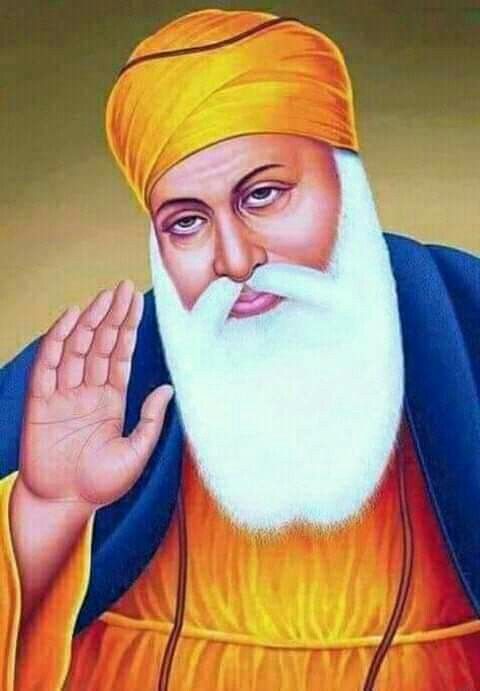
Guru Nanak
A prominent Indian spiritual teacher and the founder of Sikhism, the first of the ten Sikh Gurus, who taught the oneness of God and human equality.
This biography of Guru Nanak helps you learn English through real historical stories.
born1469
died1539
nationalityIndian
known forfounding Sikhism and his extensive spiritual travels (Udasis)
fieldreligion and spirituality
Key Takeaways
- He founded Sikhism, teaching the absolute oneness of God (Ik Onkar)
- He undertook four major journeys (Udasis) across Asia and the Middle East to spread peace
- He established the Langar, a free community kitchen to promote social equality
- He rejected caste divisions and taught that true spirituality involves honest living and selfless service
Life Timeline
1469
Born in Nankana Sahib
1496
Experienced a divine revelation after disappearing in a river
1500
Began his first of four major Udasis (spiritual journeys)
1522
Established the Kartarpur community and the Langar
1539
Appointed Guru Angad as his successor and passed away
Biography Reading: Guru Nanak
background
Guru Nanak was born in 1469 in the village of Talwandi, now known as Nankana Sahib in present-day Pakistan. Growing up in a society deeply divided by caste and religious strife between Hindus and Muslims, he displayed a profound spiritual inclination from a young age. At the age of 27, his life took a monumental turn when he disappeared into the Bein River for three days. Upon emerging, he proclaimed a divine revelation: "There is no Hindu, there is no Muslim," emphasizing the shared humanity and the single divine light present in everyone.
achievement
To share his message of universal brotherhood and the oneness of God (Ik Onkar), Guru Nanak embarked on four extensive spiritual journeys known as "Udasis." He traveled thousands of miles across India, Tibet, the Middle East, and beyond, engaging in philosophical dialogues with scholars and holy men of various faiths. He taught that spiritual liberation could be achieved not by renouncing the world as an ascetic, but through honest labor, truthful living, and continuous remembrance of the divine while fulfilling one's family and social duties.
impact
In the later part of his life, Guru Nanak settled in Kartarpur, where he founded a revolutionary egalitarian community. He institutionalized the "Langar," a free community kitchen where people of all castes, genders, and social statuses sat together on the floor to share a meal, directly challenging the deeply ingrained social hierarchies of his time. Before his passing in 1539, he appointed a successor to continue his work, successfully laying the unshakeable foundation for Sikhism, a global religion that continues to champion equality, selfless service, and devotion.
Essential Vocabulary
inclination
a person's natural tendency or urge to act or feel in a particular way
brotherhood
the feeling of kinship with and closeness to a group of people or all people
renounce
to formally declare one's abandonment of a claim, right, or possession
egalitarian
believing in or based on the principle that all people are equal and deserve equal rights
institutionalize
to establish something as a convention or norm in an organization or culture
hierarchy
a system in which members of a society are ranked according to relative status or authority
Knowledge Check Quiz
FACTUAL1 / 4
What is the name of the free community kitchen established by Guru Nanak?
Flashcards
Flashcard
Who is the founder of Sikhism?
Guru Nanak.
1 / 9