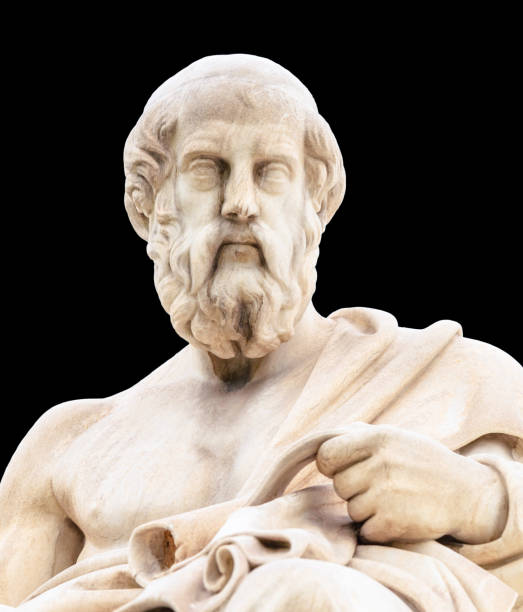
Plato
An ancient Greek philosopher who founded the Academy in Athens and profoundly shaped Western philosophy with his Theory of Forms.
This biography of Plato helps you learn English through real historical stories.
bornc. 428/427 BC
diedc. 348/347 BC
nationalityGreek (Athenian)
known forfounding the Academy, the Theory of Forms, and writing 'The Republic'
fieldphilosophy
Key Takeaways
- He founded the Academy in Athens, the first institution of higher learning in the West
- He developed the Theory of Forms, arguing that non-physical ideas represent the most accurate reality
- He wrote 'The Republic', exploring justice and the concept of philosopher-kings
- He preserved and expanded upon the teachings of his mentor, Socrates, through written dialogues
Life Timeline
c. 428 BC
Born in Athens to an aristocratic family
c. 407 BC
Became a devoted student of Socrates
399 BC
Witnessed the trial and execution of his mentor, Socrates
c. 387 BC
Founded the Academy in Athens, the first institution of higher learning in the Western world
c. 375 BC
Wrote his most famous dialogue, 'The Republic'
c. 348 BC
Died in Athens
Biography Reading: Plato
background
Plato was born around 428 BC in Athens, Greece, into a wealthy and politically active aristocratic family. As a young man, he was highly educated in grammar, music, and gymnastics, initially aspiring to a career in politics or poetry. However, his life took a dramatic turn when he met Socrates. Plato became his most devoted student, deeply inspired by Socrates's relentless pursuit of truth and virtue. The tragic execution of his beloved mentor in 399 BC deeply disillusioned Plato with Athenian democracy, prompting him to travel extensively across the Mediterranean to study mathematics, geometry, and religion.
achievement
Upon returning to Athens around 387 BC, Plato founded the Academy, which is widely considered the first institution of higher learning in the Western world. It was here that he taught his most famous student, Aristotle. Plato is best known for his "Theory of Forms," which argues that the physical world we see is merely a shadow or imperfect copy of a higher, spiritual realm of perfect, eternal Ideas (or Forms). He famously illustrated this concept using the "Allegory of the Cave," describing people chained in a dark cave who mistake shadows on a wall for absolute reality, until one escapes into the sunlight of true knowledge.
impact
Plato's philosophical ideas were brilliantly captured in his written dialogues, where he often used Socrates as the main character to explore complex concepts like justice, beauty, and equality. In his masterpiece, "The Republic," he envisioned an ideal utopian society ruled not by wealthy politicians or kings, but by wise "philosopher-kings" who possessed true knowledge of the good. Until his death around 348 BC, Plato continuously sought to elevate human understanding beyond the material world. His profound writings laid the absolute foundations for Western philosophy, science, and political theory for millennia to come.
Essential Vocabulary
aristocratic
belonging to the highest social class, often holding hereditary titles or offices
disillusioned
disappointed in someone or something that one discovers to be less good than one had believed
allegory
a story, poem, or picture that can be interpreted to reveal a hidden meaning, typically a moral or political one
utopian
modeled on or aiming for a state in which everything is perfect; idealistic
realm
a field or domain of activity or interest
dialogue
a conversation between two or more people as a feature of a book, play, or film
Knowledge Check Quiz
FACTUAL1 / 4
What was the name of the school Plato founded in Athens?
Flashcards
Flashcard
Who was Plato?
An ancient Greek philosopher who founded the Academy.
1 / 9