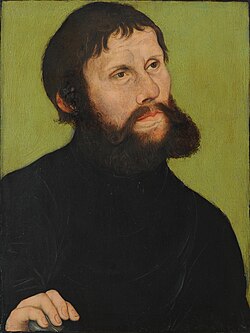
Martin Luther
A German priest, theologian, and key figure of the Protestant Reformation who challenged the Catholic Church's practices.
This biography of Martin Luther helps you learn English through real historical stories.
born1483
died1546
nationalityGerman
known forinitiating the Protestant Reformation and the 95 Theses
fieldreligion and theology
Key Takeaways
- He sparked the Protestant Reformation by challenging the corrupt practices of the Catholic Church
- He famously nailed his 95 Theses to the church door in Wittenberg in 1517
- He believed salvation was achieved through faith alone, not by purchasing indulgences
- He translated the Bible into everyday German, making it accessible to common people
Life Timeline
1483
Born in Eisleben, Saxony
1505
Became an Augustinian monk
1517
Nailed the 95 Theses to the door of the Wittenberg Castle Church
1521
Excommunicated by the Pope and stood trial at the Diet of Worms
1522
Published his German translation of the New Testament
1546
Died in Eisleben
Biography Reading: Martin Luther
background
Martin Luther was born in 1483 in Eisleben, Germany. His father, a prosperous copper miner, wanted him to become a lawyer. Luther began studying law but experienced a life-changing event in 1505 when he was caught in a terrifying thunderstorm. Fearing for his life, he vowed to become a monk if he survived. True to his word, he abandoned his legal studies and entered an Augustinian monastery, where he devoted himself to fasting, long hours in prayer, and constant confession.
achievement
Despite his strict monastic life, Luther felt a deep sense of spiritual inadequacy. Through his study of the Bible, he came to believe that salvation is a gift from God received through faith alone, not through good works or purchasing indulgences (certificates that supposedly reduced punishment for sins). In 1517, outraged by the corrupt sale of indulgences by the Catholic Church, Luther drafted his famous "95 Theses"—a list of arguments and critiques—and famously nailed them to the door of the Castle Church in Wittenberg. Thanks to the newly invented printing press, his ideas spread like wildfire across Europe.
impact
Luther's bold defiance sparked the Protestant Reformation, permanently fracturing Western Christianity. In 1521, he was excommunicated by the Pope and summoned before the Holy Roman Emperor at the Diet of Worms. Commanded to recant his writings, Luther famously refused, stating that his conscience was captive to the Word of God. He was declared an outlaw but was protected by sympathetic German princes. While in hiding, he translated the New Testament into everyday German, making the Bible accessible to ordinary people for the first time. He died in 1546, leaving a legacy that profoundly reshaped religious, cultural, and political history.
Essential Vocabulary
Reformation
a 16th-century movement for the reform of abuses in the Roman Catholic Church ending in the establishment of the Reformed and Protestant Churches
monastery
a building or buildings occupied by a community of monks living under religious vows
indulgence
a grant by the Pope of remission of the temporal punishment in purgatory still due for sins after absolution
excommunicate
officially exclude someone from participation in the sacraments and services of the Christian Church
recant
say that one no longer holds an opinion or belief, especially one recognized as heretical
conscience
an inner feeling or voice viewed as acting as a guide to the rightness or wrongness of one's behavior
Knowledge Check Quiz
FACTUAL1 / 4
What document did Martin Luther famously nail to the door of the Castle Church in Wittenberg?
Flashcards
Flashcard
Who sparked the Protestant Reformation in 1517?
Martin Luther.
1 / 9